
PENALTIES AND DISCOURAGEMENT: IS THE VICTIM COMPENSATED? - WITH REFERENCE TO THE PUBLIC EXAMINATIONS ACT
Category: ARTICLE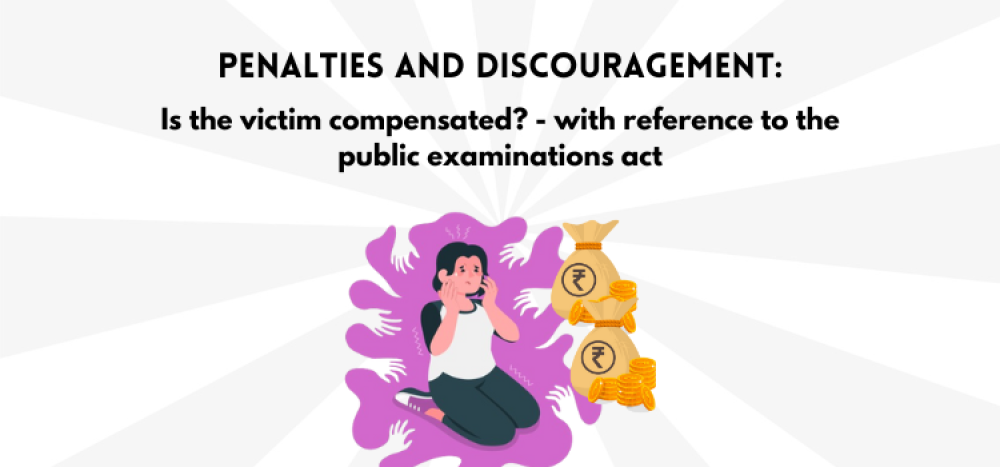
「 ✦ Content ✦ 」
It does not advocate prevention of paper leaks but rather seeks to shift the focus on compensation of the victims. Here, the author highlights a range of different views as compensation to revive educational opportunities and keep exams’ honesty. The author describes such measures as both caring for the victims and playing the preventative role in strengthening society’s belief in law. In this article the author elaborates on how this focus on the victim will improve fairness, equality in chances and possibly be a better deterrent than punitive measures alone.
Keywords: Examination malpractice, Punishment, Deterrence theory, Victim compensation, Educational opportunities, Structural changes, Psychological support, Career consequences.
Introduction:
The Public Examinations (Prevention of Unfair Means) Act, 2024 is anti-examination malpractice legislation in India. It provides for stiff measures for the offenders which entails a minimum of three years imprisonment term with an additional imprisonment term of up to five years for any general offender, ten years for any general offender who is a manager at the service provider handling the examination or any other similar organization.
It is specifically difficult to conclude the Act’s effectiveness in prevention and if it creates an optimal environment for victim-oriented justice. Another weakness of the Act is that despite numerous concerns being raised, punishment has been seen as the main sanction of the Act more than crime prevention and victim support. It does not also point out the breakdown of other structures that has led to examination malpractice including corruption and insecurity.
The idea that serious penalties for pre-crime activities will deter potential offenders is doubtful, particularly in relation to the members of organized crime groups who participate in exam fraud. Notably, the Act does not address the requirements of direct compensation or support of the victims of examination malpractice in terms of their immediate needs after suffering the malpractice and the impacts on their lives and the society at large.
The Limitations of Deterrence Theory
The main justification for the Act is based on the deterrence theory which has its weakness. It fails to recognize the need to be certain, expeditious, and severe in the enforcement of laws and the dispensation of justice. The fact that potential offenders assess the risks and benefits, the theory negates the offenders’ complicated reasons such as financial circumstances and even organizational greed.
Thus, organized criminal networks require individual prosecution, and individual punishments may possess relatively low deterrent potential. Excessive penalties may also introduce more efficient forms of cheating or deter useful knowledge. This preoccupation with deterring examination malpractice through severe penalties could be counterproductive in attaining the Act’s objectives hence may not eradicate the examine malpractice’s root causes.
The Neglected Victims:
The following has been identified as areas of concern with the Public Examinations Act: These campaigns led to enhancement of examination malpractice while the victims of these malpractices, the students whose education and career prospects have been derailed and ignored in their struggle for their rights. In one way, the Act aims at penalising the offenders involved in paper leakage and other unfair practices but does not award compensation or support those affected in any way. This has impacts such as missed chances to incorporate restorative justice, continuation of existing inequalities, loss of trust in the educational and justice systems, and lack of valuable ideas for how to prevent examination malpractice and improve the quality of education. This means that the Act was limited more in the way that it lost an opportunity for all-around reform and enhancement of examination practices and further, did not include the victims’ side of the story.
A Paradigm Shift: Towards Victim Compensation System and Change in Policing:
The current type of approach addressing examination malpractice lacks the ability to provide a proper and complete paradigm shift that also incorporates the victims. This includes incorporating the provisions for compensation for the victims into the Act; holding re-examination on a fair basis and also offering more assistance to the affected students. A number of structural changes like improving the framework in terms of adopting sophisticated technologies and policies as well as enhancement of the supervisory bodies of the schools and examination conducting boards are some of the most significant recommendations that may help to avoid similar scandals in the future.
Ethics should be taught at all the levels of schooling so that the culture of cheating and other ills in the society is checked. Corrective measures should ensure that offenders learn to understand what they did and take responsibility to discuss the matter with other students. Thus, practical assistance for victims plays a significant role in managing the psychological and career consequences of examination malpractice. To deal with stress and other disappointments students need to be provided with mental health care while to help extend them to other options they need specialist care in terms of their career paths.
There is also a need to have continuous improvement, therefore cyclic reviews and updates of the Act and associated policies. Students, educators and other stakeholders must be involved in the continuous process of examination integrity measures to ensure success of this new approach.
Implementing the compensation of the victims through the Public Examinations Act would be even more comprehensive way of handling examination irregularities proving that the government is not only against culprits but also for students who were unfairly deprived of their educational advancements.
Conclusion:
Even though the bill titled the Public Examinations (Prevention of Unfair Means) Act, 2024 emerged as a course of action to address the severity of exam malpractice in India, it is lacking in providing an adequate solution as it is designed based on punitive or the deterrence theory. In enhancing the compensation of victims and providing solutions to congenital problems, the Act loses other opportunities of reforming and seeking justice. An approach that is lined up with compensation, restorative justice and reforms with victims at the center of it is the better way to go. Thus, this approach serves the dual aim of attending to learner’s emergent exigencies, as well as assisting in stemming and reconstructing a future-proof, equitable, and credible educational system.
India is still trying to contend with the problem of maintaining integrity in public examinations and as such, policy makers must consider more comprehensive measures than mere punitive measures.
References:
[1] Public Examinations (Prevention of Unfair Means) Act, 2024.
[2] Section 10, Public Examinations (Prevention of Unfair Means) Act, 2024,
[3] Reflections on hanging by Koestler, Arthur, 1956.
[4] Article in Bar and Bench. < Public Examinations (Prevention of Unfair Means) Act: Can punishment alone prevent crime? (barandbench.com) >
[5] Dölling, D., Entorf, H., Hermann, D. et al. Is Deterrence Effective? Results of a Meta-Analysis of Punishment. Eur J Crim Policy Res 15, 201–224 (2009).
[6] Dr. R Mangoli, Nandini Devarmani, “Role of Victims in Criminal Justice System: A Critical Analysis from Indian Perspective” (2014) [12] SSRN.
OLQ is a Pan-India basis law firm connecting legal expertise nationwide.
WRITTEN BY: ABHISHEK S CHAUHAN
GUIDED BY: ADVOCATE ANIK


